
 Share
Share


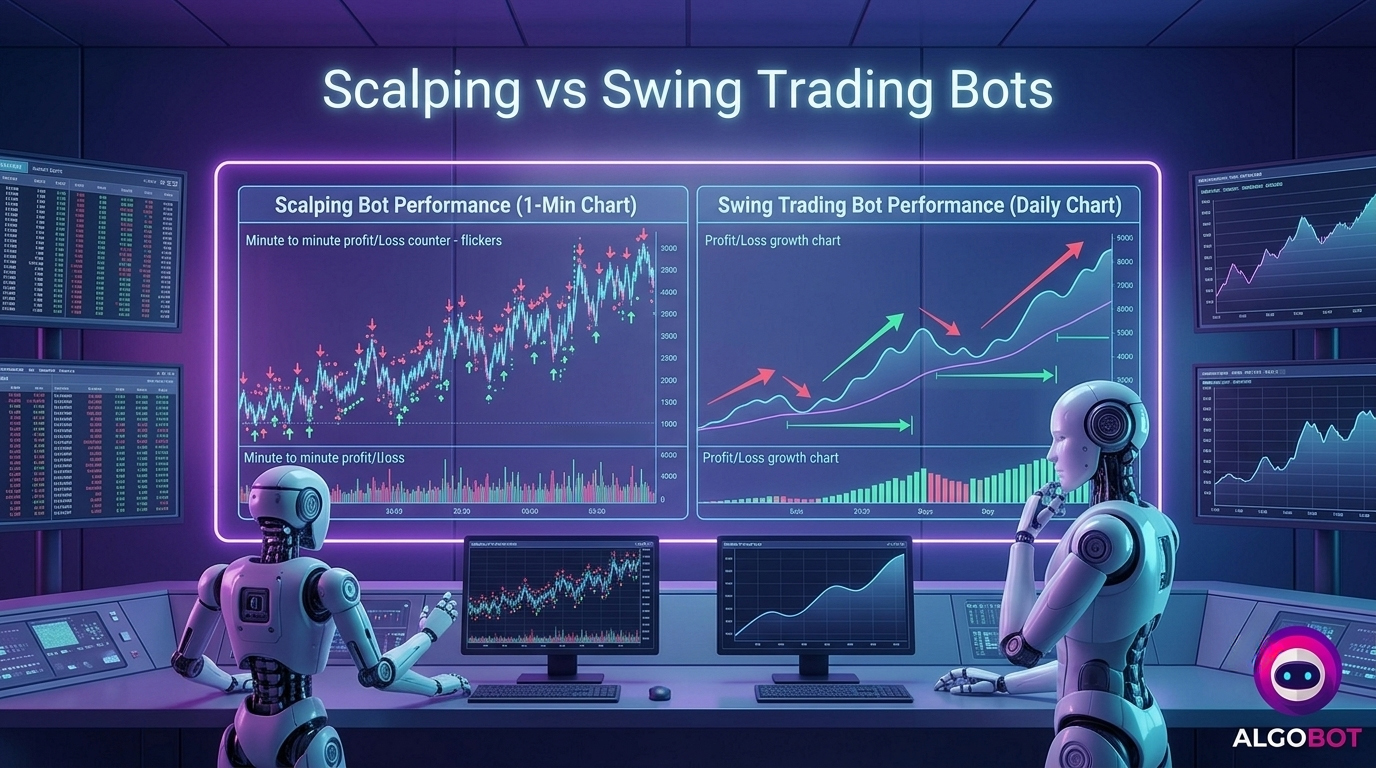
Choosing between scalping and swing trading bots comes down to matching your risk tolerance, account size, and technical setup with the right market speed. While scalping aims to capture micro-movements over minutes, swing trading targets broader multi-day trends. Both styles can be automated effectively, but they carry vastly different execution requirements and exposure risks.
Automated solutions like AlgoBot allow traders to configure execution rules for either speed without sitting in front of price charts all day. This guide breaks down the core structural differences between scalping and swing algorithms, highlighting key execution pitfalls and how to select the right approach for your trading workflow.
Key Takeaways
- Scalping algorithms rely on ultra-fast execution and tight spreads to profit from tiny, rapid price fluctuations.
- Swing trading bots focus on larger percentage moves over multi-day timeframes, making them less vulnerable to minor execution delays or slippage.
- Scalping carries severe friction risk from trading fees, spreads, and high-frequency drawdown spikes.
- Swing trading exposes capital to overnight gaps, weekend holding costs, and sudden macroeconomic news releases.
- AlgoBot accommodates both styles by pairing automated execution with customizable risk profiles, trailing stops, and position sizing filters.
Two Different Trading Speeds
Scalping bots aim to capture small moves quickly, often within minutes. Swing trading bots look for larger moves over hours or days. Both can be automated, but they require very different execution and risk assumptions.
The core distinction lies in time horizon and expected profit margin per trade. Scalping algorithms rely on high frequency and high win rates to capture tiny fractional price movements, operating primarily on 1-minute to 5-minute timeframes.
In contrast, swing trading algorithms target multi-day momentum, macro breakouts, or key structural pivots on 1-hour, 4-hour, or daily charts. Because swing strategies seek larger percentage moves, they accommodate higher individual trade variance and operate with wider profit targets.
How Scalping Bots Work
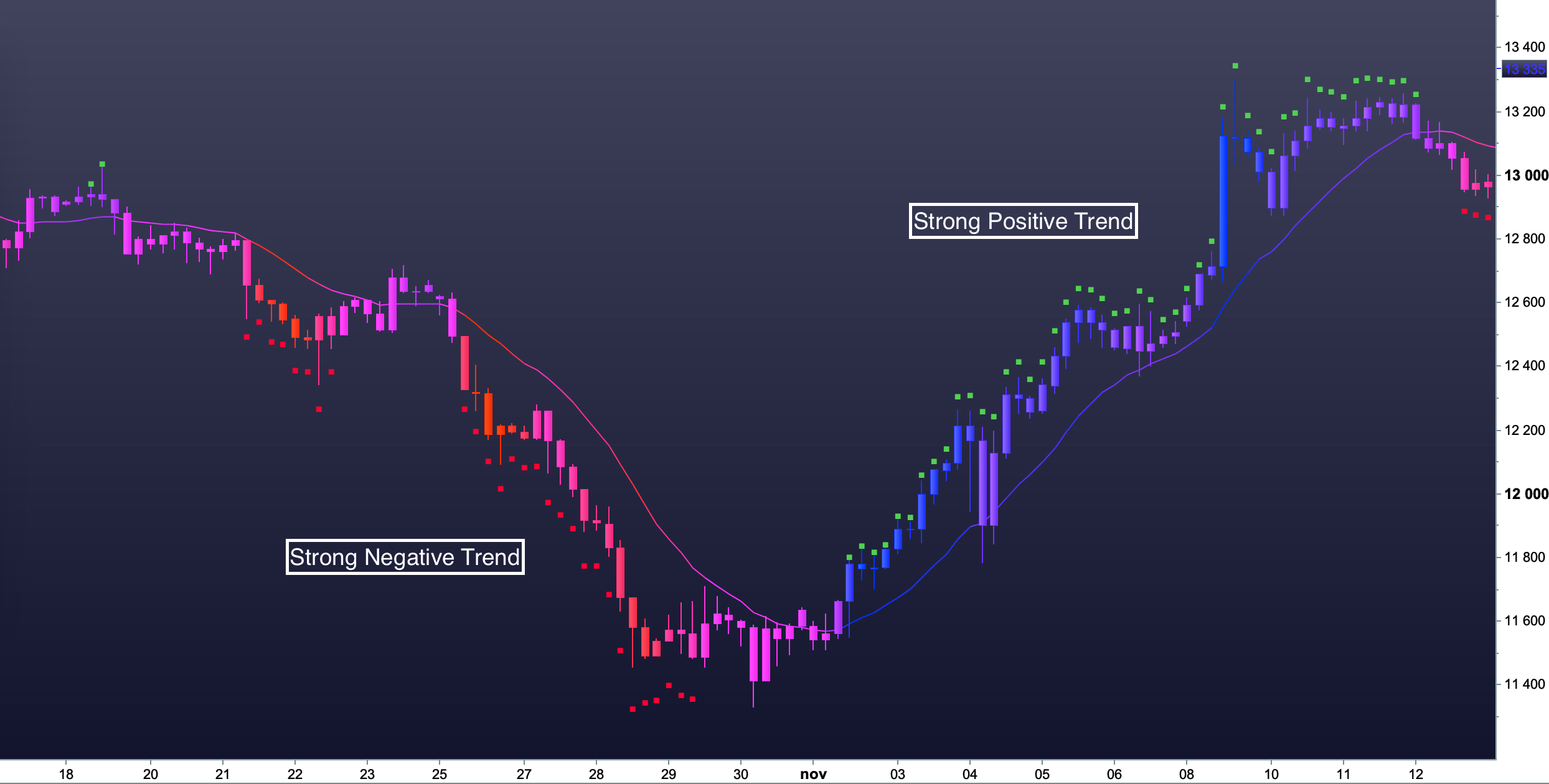
A scalping bot needs fast execution, tight spreads, low commissions, and reliable order routing. Small delays can turn a good setup into a poor one because the expected profit per trade is usually small.
High-frequency execution models are mathematically vulnerable to trading friction. If a scalping bot aims for a 5-pip profit, a 1-pip bid-ask spread combined with 0.5 pips of execution latency (slippage) erodes 30% of the gross target before the trade even develops.
Because of this tight operational envelope, automated scalping requires direct market access (DMA) or ECN broker accounts with near-zero latency. Algorithms must also monitor real-time order book depth to ensure liquidity before triggering market entries.
How Swing Trading Bots Work
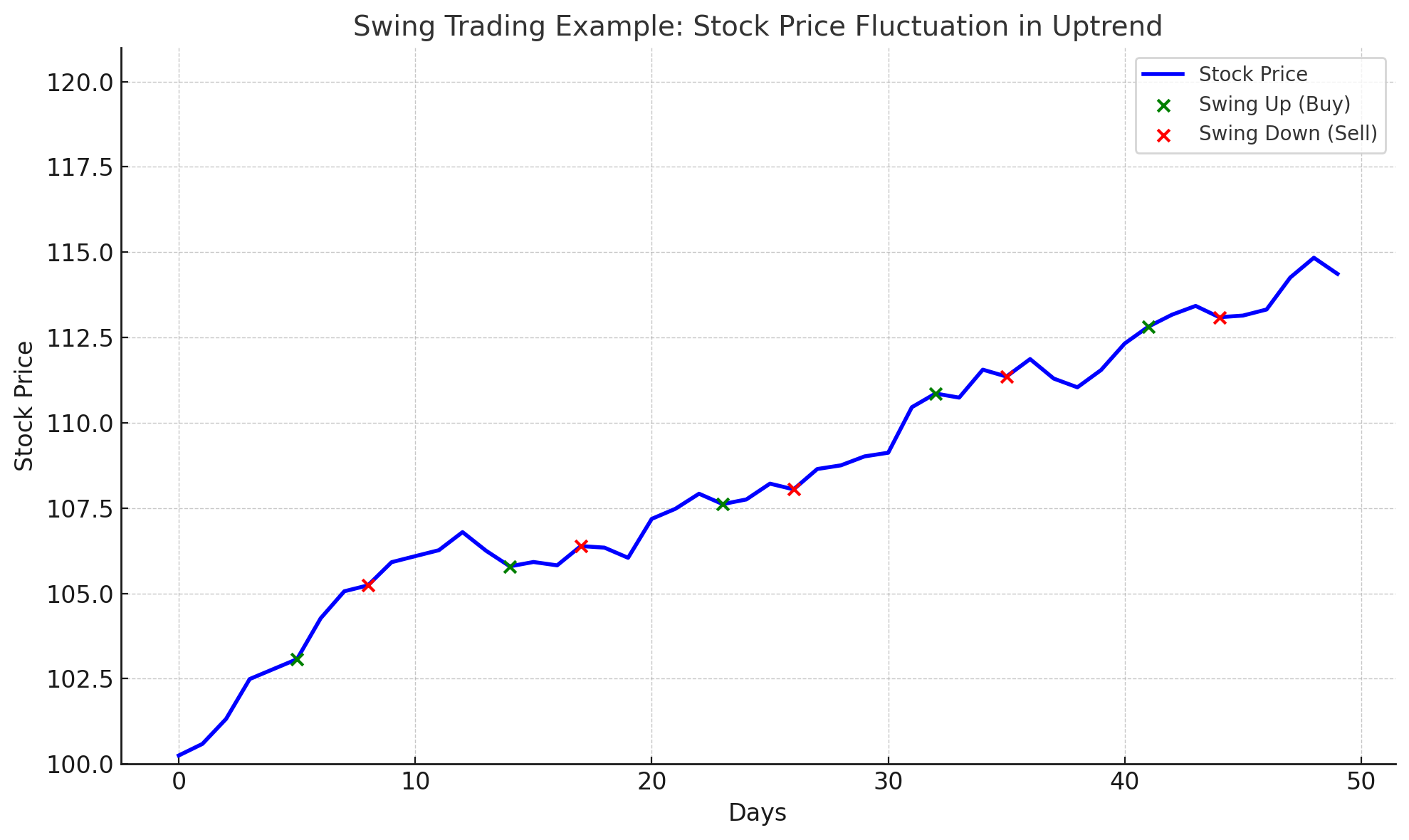
A swing bot can be less sensitive to seconds of execution delay, but it must handle overnight risk, news events, and wider stop losses. It usually trades less often but aims for larger moves.
Since swing algorithms hold positions across multiple trading sessions, they are constantly exposed to overnight gap risk, weekend swap fees, and macroeconomic news releases. Automated swing strategies typically incorporate economic calendar filters to adjust risk exposure prior to major high-impact events.
The technical architecture of a swing bot focuses on trailing stop logic and dynamic position scaling rather than execution speed. The system must continuously evaluate market structure across higher timeframes to protect accrued paper gains during multi-day trends.
Which Is Better for Beginners?
Beginners often underestimate scalping difficulty. Swing trading may be easier to monitor because there are fewer trades and less pressure. However, the right choice depends on personality, account size, and platform reliability.
From an operational standpoint, swing trading provides a significantly wider margin for error. Minor execution delays, small spread expansions, or slight broker slippage have a negligible impact on a swing trade targeting 150 pips compared to a scalp targeting 4 pips.
Additionally, swing trading bots allow retail operators to analyze system behavior in a less frantic environment. Evaluating a few high-conviction trades per week makes backtesting verification, performance tracking, and parameter adjustment far more manageable for developing traders.
Risk Differences
Scalping risk comes from spread, slippage, overtrading, and execution errors. Swing risk comes from gaps, news shocks, and holding trades through changing conditions. Both need maximum loss limits.
Scalping algorithms face compounding tail-risk during sudden volatility bursts. If market liquidity evaporates in milliseconds, a tight stop loss can experience massive negative slippage, executing far below the intended invalidation price across high trade volumes.
Swing algorithms face regime-shift risk, where unexpected geopolitical news or central bank announcements cause market gaps over the weekend or outside standard session hours. Automated risk frameworks mitigate this by utilizing smaller position sizes relative to account equity and establishing absolute account drawdown limits.
AlgoBot Risk Settings
A platform with conservative, balanced, and aggressive modes can help users choose a style that fits their tolerance. The important point is to avoid selecting aggressive settings just because they look exciting.
Risk modes translate strategy parameters—such as max position leverage, stop-loss distance, and trade frequency—into calibrated capital allocation models. A conservative profile throttles daily trade counts and caps exposure at low leverage multiples, prioritizing capital protection.
An aggressive profile allows wider drawdowns and higher trade density to capture rapid compounding during ideal market conditions. Understanding how these preset modes alter margin requirements and exposure thresholds is vital before deploying automation on live accounts.
Practical Example
Imagine a trader running a swing trading bot on Gold (XAU/USD) using 4-hour market structure breakouts. The bot detects a clean higher-high formation, calculates position size based on a 1.5% risk rule, and places an order with a 40-pip stop loss and a 120-pip profit target.
Because the bot is designed for multi-day swings, minor execution latency or minor spread widening during entry has virtually no impact on the overall risk-to-reward ratio. As the trade develops over the next 48 hours, the system automatically shifts the stop loss to breakeven once price reaches the first major resistance zone, protecting capital while allowing the trend to play out.
Common Mistakes Beginners Make
- Attempting to run scalping algorithms on standard retail accounts with high spreads and commission costs that consume most of the profit margin.
- Failing to set absolute daily loss limits, allowing a high-frequency scalping bot to execute dozens of losing trades during unpredictable news events.
- Underestimating weekend gap risk when swing trading, leaving high leverage active over market closures.
- Switching strategies too quickly after a brief losing streak instead of evaluating performance across a realistic statistical sample size.
- Ignoring rollover and swap fees when running multi-day swing automation on leveraged forex or crypto pairs.
How AlgoBot Can Fit Into the Workflow
AlgoBot supports both short-term execution and multi-day swing strategies by allowing traders to customize timing rules, entry triggers, and trade management. Swing traders can configure AlgoBot to scan for structural setups across higher timeframes while applying conservative risk profiles and trailing stops to capture prolonged market moves.
For traders focused on faster execution, AlgoBot streamlines order processing and enforces pre-set drawdown limits to prevent overtrading. By providing clear performance metrics and paper-trading environments, the platform enables users to test whether a scalping or swing approach best aligns with their risk tolerance before connecting live capital.
Final Thoughts
Scalping vs Swing Trading Bots is ultimately about structure. Traders do not need more random opinions; they need clear rules, consistent execution, and risk limits that protect them during bad conditions. Automation can help with that, especially when it is paired with education and realistic expectations.
For users comparing trading tools, the strongest platform is usually the one that makes disciplined behaviour easier: clear signals, sensible risk controls, transparent setup steps, and the ability to pause or adjust when conditions change. That is the standard beginners should use when evaluating AlgoBot or any other automated trading solution.
FAQs
Are scalping bots profitable?
Some can be, but scalping is highly sensitive to costs, execution, and market conditions.
Do swing bots trade less often?
Usually yes. They wait for larger setups and may hold positions longer.
Which style has lower stress?
For many beginners, swing trading feels less stressful because it does not require constant rapid decisions.
Educational content only. Trading involves risk, and past or historical performance does not guarantee future results.