
 Share
Share


Backtesting is a fundamental phase in developing any automated trading system, allowing you to validate whether a strategy holds a genuine mathematical edge before risking real capital. By simulating trading rules against historical price data, traders can uncover hidden weaknesses, measure drawdown, and refine entry conditions in a risk-free environment.
Platforms like AlgoBot help bridge the gap between static testing and live automation, ensuring that rules evaluated on past charts translate smoothly into real-time execution. This guide walks through the essential steps to structure a reliable forex backtest, avoid common statistical traps, and properly analyze system performance.
Key Takeaways
- Backtesting validates trading rules against historical data to establish expected profitability and risk parameters.
- To avoid misleading results, tests must account for variable spreads, broker commissions, swap rates, and slippage.
- Metrics like maximum drawdown, profit factor, and recovery factor provide a clearer picture of strategy health than win rate alone.
- Curve-fitting—over-optimizing parameters to fit historical charts perfectly—is the leading cause of strategy failure in live trading.
- AlgoBot enables traders to backtest execution workflows and transition them seamlessly into paper-trading environments before going live.
What Backtesting Means
Backtesting means applying a strategy’s rules to historical market data to see how it would have performed. It is not a guarantee of future results, but it helps traders find obvious weaknesses before risking live capital.
By simulating trade execution against historical tick or candle data, backtesting provides an objective mathematical baseline. It allows traders to evaluate whether an edge truly exists or if recent profitability was simply the result of random market variance.
In automated trading, backtesting serves as the primary debugging phase for algorithmic logic. It reveals how parameter inputs—such as indicator periods, stop-loss ratios, and exit triggers—react across diverse volatility cycles without putting real account equity on the line.
Define the Rules First
A backtest is only useful when the rules are clear. The trader should define entry, exit, stop loss, take profit, timeframe, trading sessions, and maximum open trades before testing.
Ambiguity is the enemy of reliable backtesting. Explicit parameters must be codified for every stage of the trade lifecycle, including exact entry conditions (such as a candle close beyond a moving average) and precise invalidation levels based on fixed pips or Average True Range (ATR) multiples.
Additionally, operational constraints must be defined prior to running the simulation. These include session filters (e.g., trading only during London and New York overlaps), maximum spread thresholds to avoid high-friction periods, and single-trade risk allocation rules.
Use Enough Market Data
Testing only one good week is misleading. A useful test should include trending markets, ranging markets, high-volatility events, and quiet periods. This helps reveal whether the strategy is robust or overfitted.
High-quality tick data with variable spread modeling is essential for realistic backtesting results. Evaluating a strategy over multi-year datasets ensures the algorithm encounters structural regime changes, such as central bank interest rate shifts, flash crashes, and prolonged low-volatility consolidations.
To avoid bias, traders often split historical data into “in-sample” and “out-of-sample” periods. The algorithm parameters are optimized on the in-sample data and then verified on the untouched out-of-sample data to ensure the strategy can handle unseen market conditions.
Metrics to Review
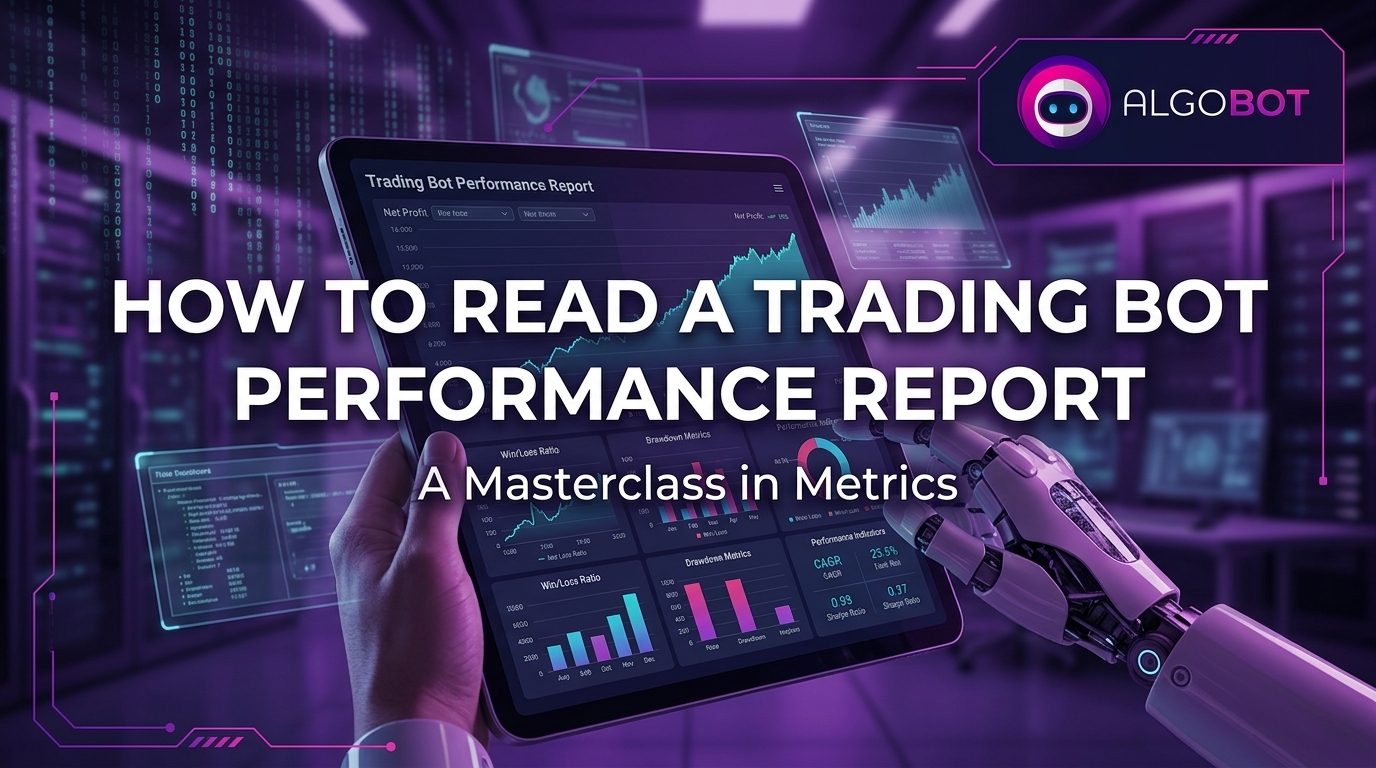
Important metrics include win rate, average win, average loss, risk-reward ratio, maximum drawdown, profit factor, and trade frequency. Win rate alone is not enough.
A high win rate can be deceptive if average losses far outweigh average gains. Traders should prioritize the Profit Factor (gross profit divided by gross loss) and Expected Payoff per trade to gauge true mathematical expectancy across a statistically significant trade sample size.
Equally critical is analyzing Maximum Drawdown (the largest peak-to-trough decline in equity) and recovery factor. Understanding the length and depth of historic losing streaks prepares traders to withstand natural drawdowns when running the system in live market environments.
Common Backtesting Mistakes
Mistakes include curve fitting, ignoring spreads and commissions, using future information by accident, and changing rules after seeing the result. A clean process matters more than a perfect-looking chart.
Curve fitting (over-optimization) occurs when strategy rules are tweaked so specifically to historical data that the bot performs flawlessly on past charts but fails immediately in real-time trading. Keeping parameter counts low and rules simple helps preserve overall strategy robustness.
Another major pitfall is look-ahead bias, where an algorithm accidentally accesses future bar information (such as high/low prices before the candle closes) during simulation. Factoring in real-world costs like commission structures, overnight swap rates, and slippage is vital to prevent artificially inflated equity curves.
From Backtest to Demo
After a backtest, the next step is demo or forward testing. This checks whether the strategy still behaves well with live spreads, slippage, and real-time execution.
Forward testing on a paper trading account bridges the gap between static historical simulation and live execution realities. It validates whether order routing, broker connection stability, and real-time indicator rendering function seamlessly under active market conditions.
Comparing live demo performance metrics against backtest expectations helps identify hidden friction points like trade latency or spread widening during news releases. Only when forward demo results align with backtest models should live capital deployment be considered.
Practical Example
Suppose a trader wants to backtest a breakouts strategy on GBP/USD across three years of historical data. Instead of assuming zero transaction costs, the trader configures the backtest environment to include realistic variable spreads averaging 1.2 pips and standard broker commission rates.
The backtest reveals that while the win rate is only 42%, the strategy maintains a healthy 1-to-2.5 risk-to-reward ratio and a Profit Factor of 1.65. Crucially, the test shows a maximum historical drawdown of 14% occurring during a low-volatility summer period, giving the trader a clear baseline of what losing streak to expect when trading live.
Common Mistakes Beginners Make
- Over-optimizing indicator settings until the historical equity curve looks artificially smooth, resulting in immediate failure during live market conditions.
- Testing strategies exclusively on short, favorable historical periods instead of across full market cycles that include high-volatility news events.
- Ignoring trading friction like bid-ask spreads, overnight swap fees, and slippage, which can turn a seemingly profitable backtest into a net loss.
- Falling victim to look-ahead bias by allowing the strategy logic to reference candle closing prices before the simulated bar has actually completed.
- Skipping the demo forward-testing phase and jumping directly from a historical backtest to live account execution.

How AlgoBot Can Fit Into the Workflow
AlgoBot streamlines the backtesting and deployment phase by providing a structured framework for testing trade logic across historical data. Traders can evaluate signal sensitivity, risk controls, and stop-loss logic under realistic market assumptions before connecting live accounts.
Once a backtest confirms a strategy’s mathematical expectancy, AlgoBot facilitates a smooth transition into forward demo testing. By monitoring real-time execution performance against historical models, users can fine-tune risk allocation and trailing stop parameters with confidence.
Final Thoughts
How to Backtest a Forex Trading Strategy is ultimately about structure. Traders do not need more random opinions; they need clear rules, consistent execution, and risk limits that protect them during bad conditions. Automation can help with that, especially when it is paired with education and realistic expectations.
For users comparing trading tools, the strongest platform is usually the one that makes disciplined behaviour easier: clear signals, sensible risk controls, transparent setup steps, and the ability to pause or adjust when conditions change. That is the standard beginners should use when evaluating AlgoBot or any other automated trading solution.
FAQs
Can a backtest prove a strategy will work?
No. It can only show how the rules performed on historical data.
How many trades should a backtest include?
More is better, but quality matters. A small sample can be misleading.
Should costs be included?
Yes. Spreads, commissions, and slippage can completely change results.
Educational content only. Trading involves risk, and past or historical performance does not guarantee future results.