
 Share
Share


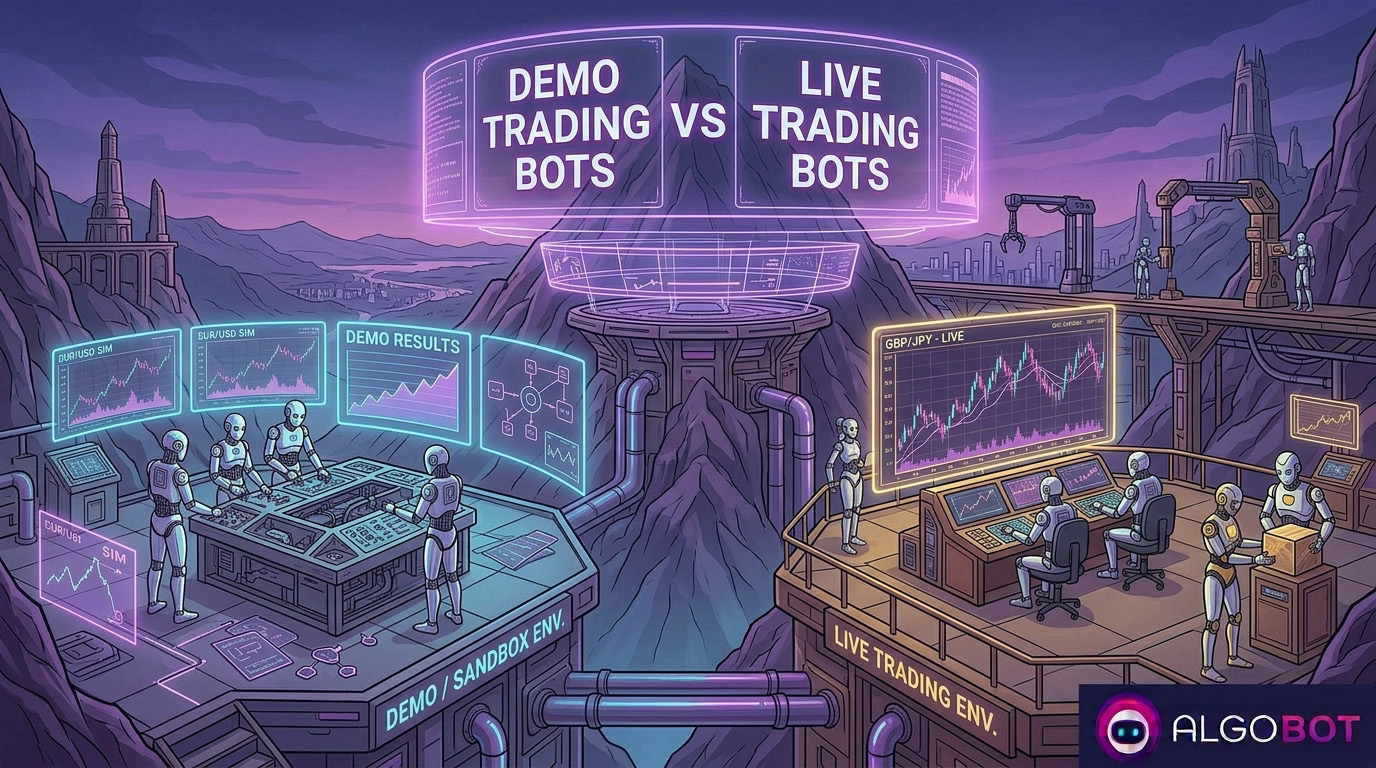
Deploying a trading algorithm in a simulated environment often produces pristine equity curves and stress-free execution. However, when traders transition from a virtual paper trading account to a real money broker environment, they frequently encounter a stark reality: a trading bot can perform very differently in demo and live markets.
Demo trading is an indispensable sandbox. It provides traders with a zero-risk testing ground to verify code syntax, validate multi-timeframe strategy rules, test API webhooks, and confirm that stop-loss logic executes as designed. Yet, despite mimicking real-time price feeds, demo environments fail to replicate the complex structural friction of live liquidity networks.
Platforms like AlgoBot support both paper testing and live execution workflows. Understanding the technical, structural, and psychological gaps between demo and live trading bots allows traders to scale their strategies safely without risking premature capital depletion.
Key Takeaways
- Demo accounts validate strategy mechanics and indicator rules, but live markets introduce real-world execution friction.
- Slippage, spread expansion, order book depth, and liquidity voids do not exist in standard simulated environments.
- Emotional intervention—such as overriding a bot during drawdowns—is a uniquely live-market risk.
- Transitioning safely requires a phased approach: backtest, paper trade, deploy micro-lot live sizing, and scale up only upon verified stability.
- AlgoBot bridges the demo-to-live gap by offering unified automation controls across both simulated setups and live exchange accounts.
Why Demo Performance Does Not Equal Live Results
Many traders assume that because a trading bot generates consistent virtual profits over a 30-day demo test, it is automatically ready for substantial live capital. This assumption ignores the fundamental differences in how orders are processed behind the scenes.
In a demo account, buy and sell orders are instantly matched by a simulated server at exact requested prices. In a live market, every order must be routed to real liquidity providers, matched against real counterparty order books, and executed within fluctuating market spreads.
The Technical Gaps: Execution Friction in Live Markets
To understand why live trading bots deviate from demo performance, traders must account for four distinct execution forces:
1. Order Slippage
Slippage occurs when a bot submits an order at one price, but the trade fills at a worse price due to rapid price movement or thin market depth. Demo accounts never suffer from negative slippage—they fill limit and market orders instantly at the displayed price tick. In live automated scalping, slippage of just 0.5 pips per trade can eliminate a strategy’s statistical edge over time.
2. Dynamic Spread Widening
During low-liquidity periods (such as daily market rollover at 17:00 EST) or high-impact macroeconomic news releases (e.g., US Inflation CPI or NFP reports), live bid-ask spreads expand dramatically. Demo accounts frequently maintain fixed or artificially tight spreads. A live bot executing a market order during news may pay 5 to 10 times the standard spread, triggering premature stop losses.
3. Liquidity and Partial Fills
If a trading bot attempts to enter a large order size on an exotic forex pair or low-cap cryptocurrency, live markets may lack sufficient volume at that exact price level, resulting in partial fills or delayed execution. Demo accounts simulate infinite liquidity, filling multi-lot orders effortlessly without market impact.
4. Broker Latency and Re-Quotes
The physical routing distance between your automated server (VPS) and the broker’s execution bridge introduces millisecond latency. During turbulent markets, this delay can result in order re-quotes or rejected trade tickets in live accounts.
Comparing Demo and Live Trading Environments
The table below summarizes the key operational differences between simulated paper trading and live account execution:
| Feature / Factor | Demo Trading Environment | Live Trading Environment |
|---|---|---|
| Order Filling | Instant, guaranteed fill at exact price | Subject to slippage, requotes, & market speed |
| Spreads | Static or ideal tight spreads | Variable; expands sharply during volatility |
| Liquidity Depth | Theoretical infinite depth | Limited by real market order books |
| Traders’ Psychology | Zero emotional impact; detachment | Fear, greed, and urge to manually intervene |
The Human Factor: Emotional Interference in Live Trading
Although automated bots are programmed to remove human emotion, human traders remain in control of the software’s “start” and “stop” buttons.
In a demo account, seeing a trading bot hit three consecutive losses causes zero anxiety. The trader allows the algorithm to run naturally through its statistical drawdown curve.
In a live account, that same three-trade losing streak involves real account equity. Fear often causes traders to manually close trades early, disable the bot right before a winning setup occurs, or alter risk parameters mid-session. This emotional interference destroys the bot’s mathematically proven edge.

The 5-Step Blueprint: Transitioning Safely from Demo to Live
Rushing from demo testing directly to large live accounts is one of the leading causes of strategy failure. To mitigate risk, follow this disciplined 5-step deployment framework:
- Strategy Optimization & Backtesting: Validate strategy rules over multi-year historical data to establish baseline expectancy, win rate, and maximum drawdown metrics.
- Paper Trading Validation (2 to 4 Weeks): Run the automated bot on a live demo feed to verify that indicator logic, webhooks, and execution timings operate bug-free.
- Micro-Lot Live Deployment (Cent or Nano Account): Deploy the bot on a live account using the smallest possible position sizing (e.g., 0.01 micro-lots). This tests real-world slippage and spread execution without risking significant capital.
- Execution Audit: Compare real-world live order fills against demo trade logs. If live slippage and spreads do not significantly degrade the strategy edge, the bot passes validation.
- Gradual Capital Scaling: Increase position sizing incrementally as the bot demonstrates stable performance over a meaningful sample size (50+ live trades).
Practical Scenario: The GBP/USD Breakout Bot Transition
Consider a trader who developed an automated 15-minute breakout bot on GBP/USD. During a 30-day demo test, the strategy yielded a 65% win rate with an average profit per trade of 12 pips.
Instead of funding the live bot with $10,000 immediately, the trader deploys the strategy with a $500 micro-account. Over 30 live trades, the trader notes that real-world slippage reduces the average profit per trade from 12 pips down to 9.5 pips.
Because the strategy maintains a healthy profit factor despite slippage, the trader confirms that the algorithmic edge is genuine. The trader can now systematically add capital, confident that real-market friction has been accounted for in their risk model.

Common Pitfalls When Moving to Live Execution
- Treating Demo Profits as Guaranteed Income: Assuming paper trading wins guarantee live returns without accounting for real execution costs.
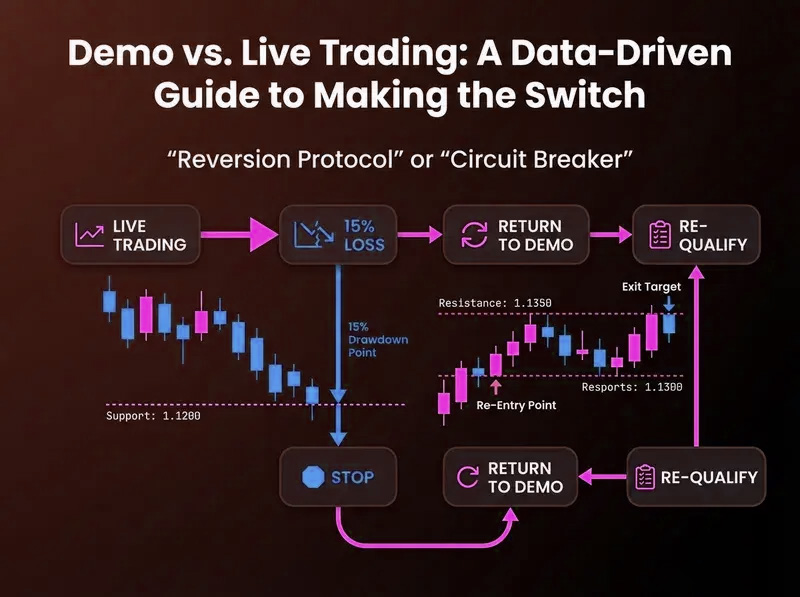
- Changing Rules Mid-Drawdown: Disabling or tweaking an algorithm during normal historical drawdown periods out of panic.
- Ignoring Broker Spread Variance: Testing a bot on a zero-spread demo feed while deploying it on a high-markup live account.
- Over-Leveraging Micro Accounts: Using maximum allowable leverage on small live accounts, leading to rapid margin calls during volatility spikes.
How AlgoBot Facilitates a Seamless Transition
AlgoBot is engineered to streamline the path from initial testing to live execution. The platform allows traders to deploy identical strategy logic seamlessly across both paper-trading demo accounts and live broker APIs without rewriting code or reconfiguring parameters.
By providing standardized trade routing, dynamic position sizing, and automated risk controls, AlgoBot minimizes technical discrepancies between environments. This allows traders to focus on auditing execution performance and scaling capital systematically.
Final Thoughts
Demo trading bots vs live trading bots is not a debate over which tool is better—it is an understanding of how simulated environments prepare you for live market reality. Demo accounts serve as the ultimate proving ground for strategy logic, code stability, and system workflows. However, live execution remains the true test of algorithmic performance and risk discipline.
By treating demo success as preparation rather than proof, auditing real-world execution costs on small position sizes, and leveraging AlgoBot’s automation tools, traders can confidently transition from paper trading to live market success.
FAQs
Why did my bot make money on demo but lose money on live?
This usually happens due to real-world market friction: order slippage, wider live spreads, broker latency, or emotional intervention like manually closing trades early.
How long should I test a trading bot on demo before going live?
A minimum of 2 to 4 weeks (or at least 50 to 100 executed trades) is recommended to observe how the bot handles changing market regimes and volatility spikes.
What is the safest way to start live trading with a bot?
Start with micro-lot position sizing (0.01 lots) on a live account. This allows you to verify real market execution and slippage with minimal financial risk before scaling up capital.
Educational content only. Trading involves risk, and past or historical performance does not guarantee future results.