
 Share
Share



With dozens of automated trading platforms on the market, choosing the right trading bot platform requires looking past marketing claims and focusing on core functionality. The ideal platform must support your preferred markets, integrate cleanly with your broker or exchange, and provide robust risk controls that protect your portfolio during adverse conditions.
AlgoBot is positioned as a multi-market automation solution designed for traders seeking structure across Forex, crypto, and traditional assets. This buyer’s guide outlines the exact criteria to evaluate when selecting a trading bot platform.
Key Takeaways
- Ensure the platform natively supports your specific asset class—whether Forex (MetaTrader), crypto (exchanges), or commodities.
- Look for platforms that emphasize stop-loss automation, max daily drawdown limits, and easy pause functionality.
- Low-friction Webhook, Telegram, and API setups reduce configuration errors that cause missed or erroneous trades.
- Avoid “black-box” systems; choose platforms that clearly explain entry logic, risk parameters, and operational behavior.
- AlgoBot offers a complete multi-market framework combining strategy signals, execution bridges, and educational resources.
Start With the Market You Trade
The best platform depends on whether you trade forex, crypto, indices, commodities, or multiple markets. A forex trader may care about MT4 and MT5 support, while a crypto trader may care about exchange integrations and 24/7 order management.
Market architecture dictates technical requirements. Forex markets operate through broker bridge connections and MetaTrader infrastructure with specific spread dynamics, whereas cryptocurrency markets rely on continuous REST and WebSocket exchange APIs operating across uninterrupted weekly cycles.
Evaluating multi-market support ensures that a chosen platform natively handles the order types, leverage mechanisms, and execution speed required for your specific asset class, avoiding execution bottlenecks during high-volume periods.
Check Strategy Transparency
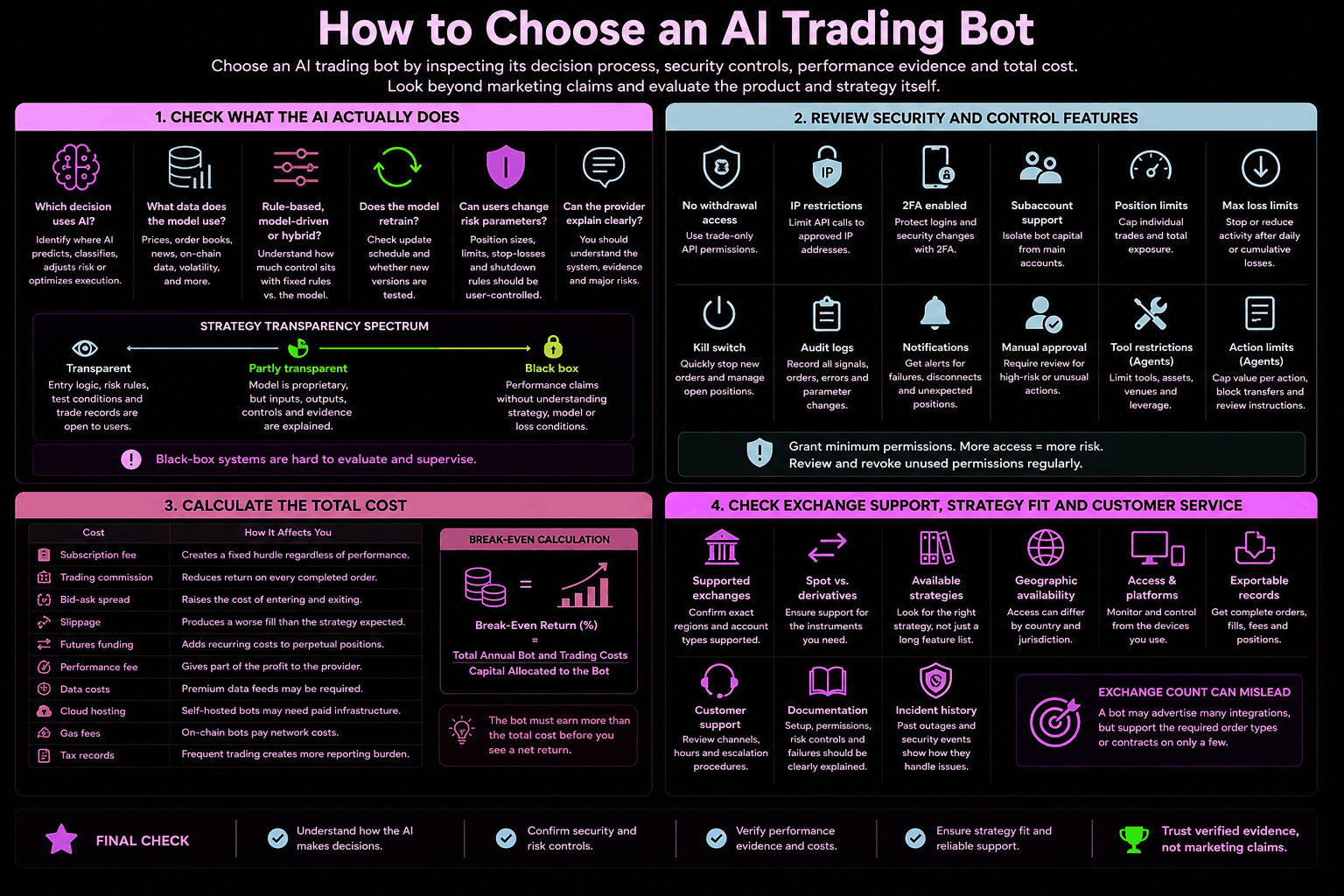
A platform does not need to reveal every proprietary detail, but users should understand the broad strategy style, risk settings, and how trades are managed. Black-box promises without risk information should be treated carefully.
Transparent systems clearly outline indicator logic, entry triggers, exit conditions, and underlying technical parameters. Knowing whether an algorithm relies on trend-following momentum, mean reversion, or statistical arbitrage allows traders to align software choices with current market regimes.
Platforms that obscure operational mechanics behind vague claims often conceal aggressive risk behaviors, such as hidden martingale scaling or unhedged exposure, which can severely compromise portfolio safety during unexpected market shocks.
Review Automation Options
Some users want fully automated execution. Others want alerts and manual confirmation. The best platform should support the level of control the trader actually wants.
Execution flexibility enables a smooth transition from beginner monitoring to advanced automation. Semi-automated setups deliver real-time notifications via Webhooks or Telegram, granting traders full discretionary authority to review market context before placing orders.
Fully automated workflows eliminate manual latency by executing orders directly through exchange APIs, ideal for strategies requiring rapid execution speed or continuous 24/7 rule enforcement without human oversight.
Look at Risk Management
Risk settings, stop-loss logic, take-profit structure, maximum exposure, and easy pause controls are essential. A platform that makes it easy to increase risk but hard to limit losses is not beginner-friendly.
Essential risk infrastructure includes hard stop-loss enforcement, trailing profit locks, position sizing calculators, and customizable maximum daily drawdown caps. These controls prevent single volatile events from causing catastrophic account losses.
Emergency controls, such as a one-click global panic button or automated API disconnect toggles, give traders immediate authority to freeze active strategies and flatten positions when abnormal market conditions arise.
Consider Integrations and Setup
A good platform should explain how to connect brokers, exchanges, TradingView, Telegram, MT4, MT5, or connector tools. Setup friction matters because configuration mistakes can create trading mistakes.
Seamless connectivity relies on robust Webhook architecture, pre-configured API templates, and verified bridge software that reduces latency between signal generation engines and broker order books.
Clear documentation and step-by-step setup guides minimize user configuration errors during API key pairing, IP whitelisting, and permission mapping, ensuring orders route accurately under live trading conditions.
Support, Education, and Reporting
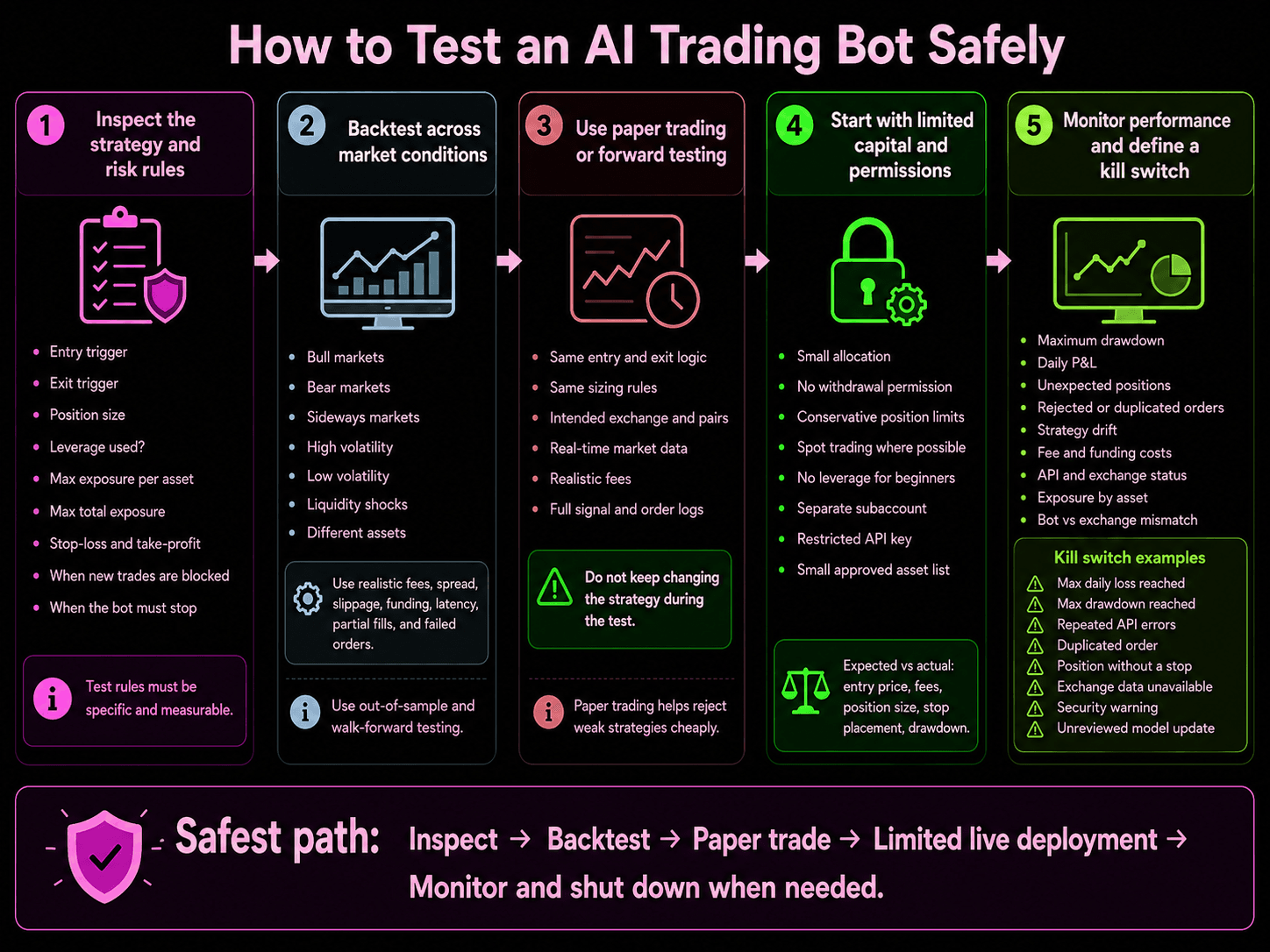
Education helps users understand what the bot is doing. Reporting helps users judge performance. Support matters when an integration breaks or a user needs help with onboarding.
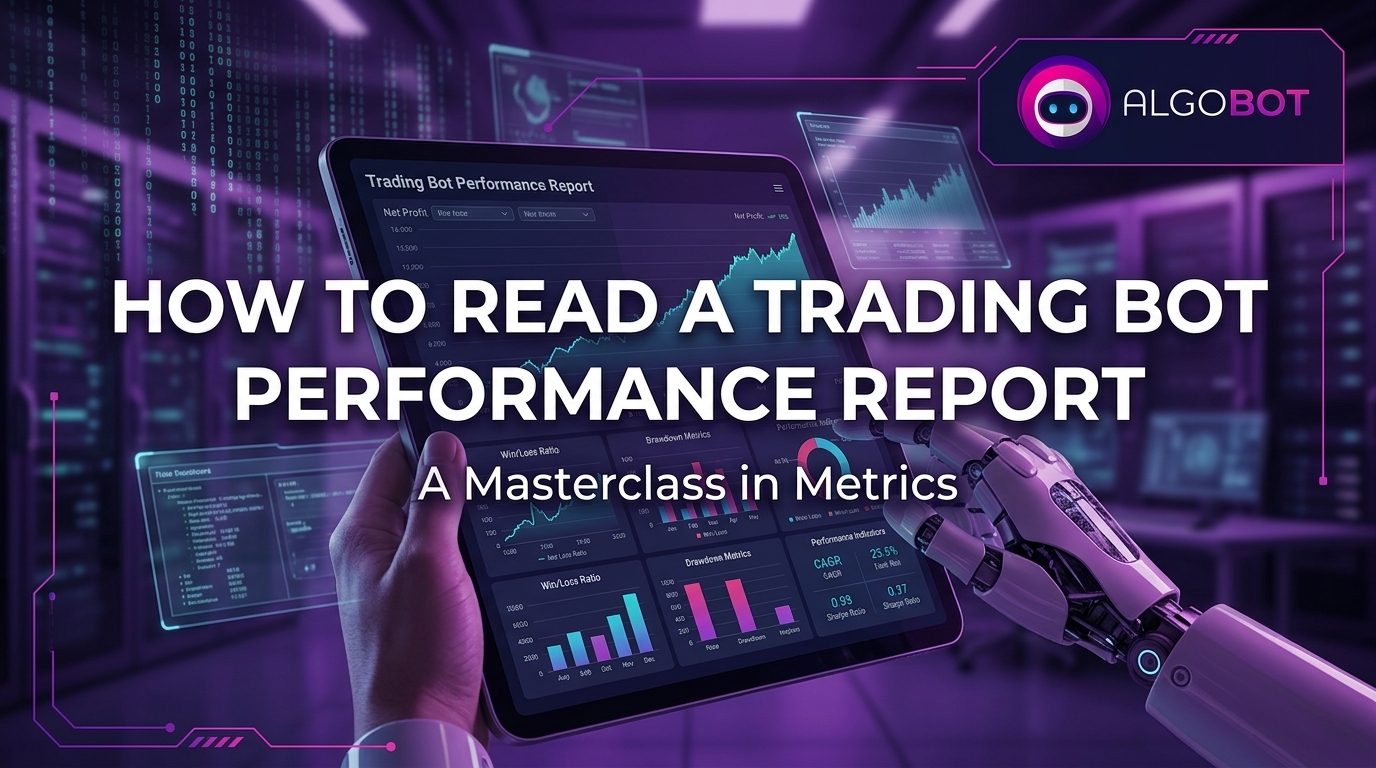
Comprehensive analytics dashboards should track performance metrics beyond simple win rates, displaying metrics like Sharpe ratios, maximum drawdown depth, average profit-to-loss ratios, and execution slippage across timeframes.
Responsive technical support paired with accessible educational documentation ensures traders can resolve API disconnects or strategy configuration questions promptly, maintaining operational confidence.
Where AlgoBot Is Positioned
AlgoBot is positioned as a multi-market automated trading tool with signals, integrations, risk settings, and educational resources. That makes it relevant for users who want more structure than a chart indicator but more flexibility than a single-market bot.
By bridging the gap between raw signal providers and fully autonomous algorithms, AlgoBot provides an adaptable environment compatible with crypto, forex, and traditional financial instruments across diverse trading styles.
Integrated risk presets and modular connectivity options allow users to customize automation levels to match their specific experience, technical capability, and risk tolerance profile.
Practical Example
A multi-asset trader manages positions across forex pairs, crypto assets, and commodities. Using fragmented tools across multiple platforms often leads to messy execution, mismatched risk settings, and configuration mistakes. By selecting a unified trading bot platform, the trader configures a single dashboard to monitor Webhook alerts from TradingView, route forex orders to MetaTrader, and manage crypto spot positions via API—all while maintaining standardized risk controls and drawdown limits across their entire portfolio.
Common Mistakes Beginners Make
- Choosing a platform based on flashy advertised win-rate percentages rather than transparent risk management tools.
- Selecting single-market platforms that lack flexibility when transitioning between forex, crypto, and index markets.
- Overlooking technical setup friction, leading to configuration mistakes during broker or exchange API integration.
- Failing to verify whether a platform offers easy pause controls or emergency global exit (“panic button”) features.
- Neglecting to evaluate performance analytics beyond simple win rates, such as profit factors and maximum drawdowns.
How AlgoBot Can Fit Into the Workflow
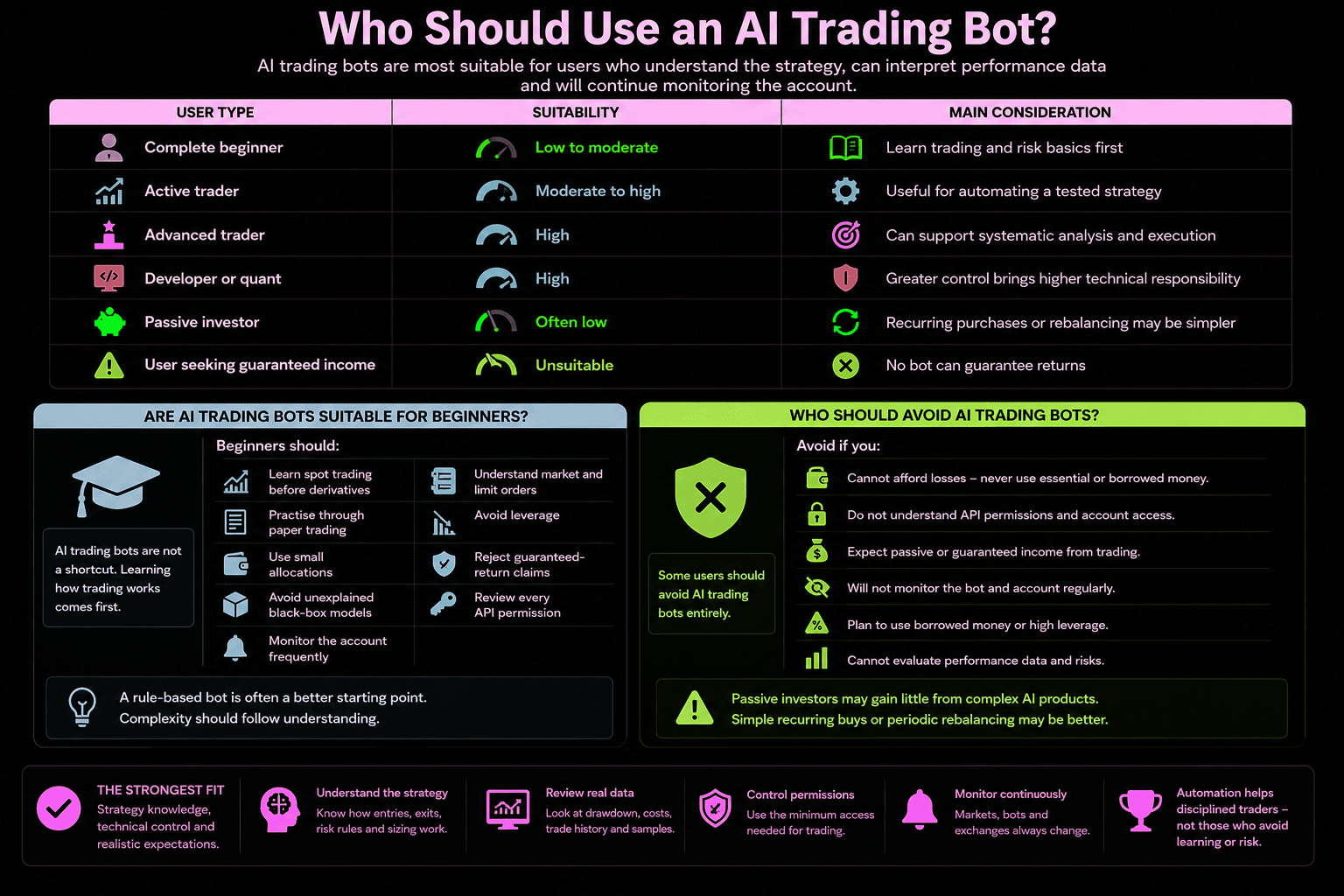
AlgoBot stands out as an all-in-one multi-asset automation platform designed for traders who value structure, security, and flexibility. Whether you trade forex, crypto, or commodities, AlgoBot brings signals, execution integrations (including TradingView, MetaTrader, and exchange APIs), customizable risk controls, and educational resources into a single workflow. It allows beginners to start safely with conservative settings and demo workflows, scaling up execution efficiency as their market experience grows.
Final Thoughts
Finding the best trading bot platform comes down to finding software that reinforces disciplined trading habits. You need a tool that makes setting risk limits easy, routes orders quickly, and works reliably across your chosen markets.
As you evaluate different platforms, test their demo capabilities, review their integration documentation, and verify their risk controls. Choosing a transparent platform like AlgoBot ensures you have the structure, safety features, and multi-market flexibility required to automate with confidence.
FAQs
What is the most important trading bot feature?
Risk management is the most important feature because losses are part of trading.
Should beginners choose full automation immediately?
Many beginners are better starting with alerts or demo automation before using full live execution.
How do I compare bot platforms?
Compare market coverage, integrations, risk controls, transparency, support, and performance context.
Educational content only. Trading involves risk, and past or historical performance does not guarantee future results.