


 Share
Share


The Relative Strength Index (RSI) is one of the most widely implemented momentum oscillators in automated forex trading strategies. By calculating the ratio of recent upward price changes to downward price changes over a specified period (typically 14 bars), RSI translates market momentum into a bounded scale from 0 to 100.
Platforms like AlgoBot utilize RSI momentum logic to construct disciplined, rule-based execution systems. Understanding how to program RSI thresholds—whether configured for mean-reversion bounces or trend-following pullbacks—allows traders to automate order entry while eliminating emotional guesswork during volatile market conditions.
RSI is rarely effective as a standalone trading trigger in live forex markets. By pairing RSI momentum logic with higher-timeframe trend filters, volatility metrics, and automated risk controls, traders can build robust algorithms that protect capital across varying market regimes.
Key Takeaways
- RSI measures the speed and magnitude of price momentum, providing automated trading bots with objective entry and exit thresholds.
- In range-bound markets, mean-reversion logic buys oversold readings (below 30) and sells overbought readings (above 70).
- In strong trending markets, bots treat RSI pullbacks toward the midline (40 to 50) as high-probability trend continuation opportunities.
- Layering secondary filters—such as Moving Averages or Average True Range (ATR)—prevents bots from taking bad trades in persistent trends.
- AlgoBot combines RSI momentum analysis with automated risk management tools to execute disciplined, rule-based forex strategies.
What RSI Measures
RSI measures the speed and size of recent price movements. Readings above 70 are often called overbought, while readings below 30 are often called oversold. In automation, these thresholds can become objective rules.
For a practical trader, the question is not only whether the idea sounds attractive. The question is whether it can be turned into repeatable rules. A repeatable rule should explain when a setup is valid, when it is invalid, how much is at risk, and what should happen if market conditions change.
This is where automated trading tools can be useful. They force the user to think in terms of conditions, thresholds, alerts, execution routes, and risk limits. That structure can reduce impulsive decisions, but it also exposes weak assumptions quickly. If a rule cannot be explained clearly, it is usually not ready to automate.
Mean-Reversion RSI Logic
A simple mean-reversion bot might look for RSI below 30, wait for price to stabilise, then enter a long position when RSI turns upward. The opposite idea can be used for shorts when RSI is extremely high.
This approach works best in range-bound markets where prices predictably bounce between support and resistance. To keep execution disciplined, the system should incorporate confirmation criteria—such as a candlestick rejection pattern—before executing the order.
In addition, mean-reversion algorithms usually implement tight stop-loss controls and dynamic profit targets near the 50 midline. Because ranging conditions can collapse into explosive breakouts, automated stops are essential to prevent heavy drawdowns when price moves against the position.
Trend-Following RSI Logic
RSI can also be used with trend filters. In an uptrend, a bot may treat RSI pullbacks toward 40 or 50 as potential continuation setups rather than waiting for a full oversold reading.
This logic prevents the bot from standing on the sidelines during strong directional moves where the index rarely drops below 30. Combining this with a higher-timeframe Moving Average ensures that entries align strictly with the broader market direction.
When programmed for trend continuation, the algorithm buys when RSI dips to the 40–50 support zone and turns upward, signaling that sellers have exhausted momentum. This approach captures low-risk entry points aligned with the dominant institutional trend.
Avoiding False Signals
RSI can stay overbought in strong trends and oversold in sharp sell-offs. Bots should therefore use stop losses, trend context, volatility filters, or support and resistance rather than trading RSI alone.
A common approach is adding an Average True Range (ATR) filter to pause trading during extreme volatility or news spikes. Layering secondary rules helps weed out low-probability entries and protects capital during prolonged market breakouts.
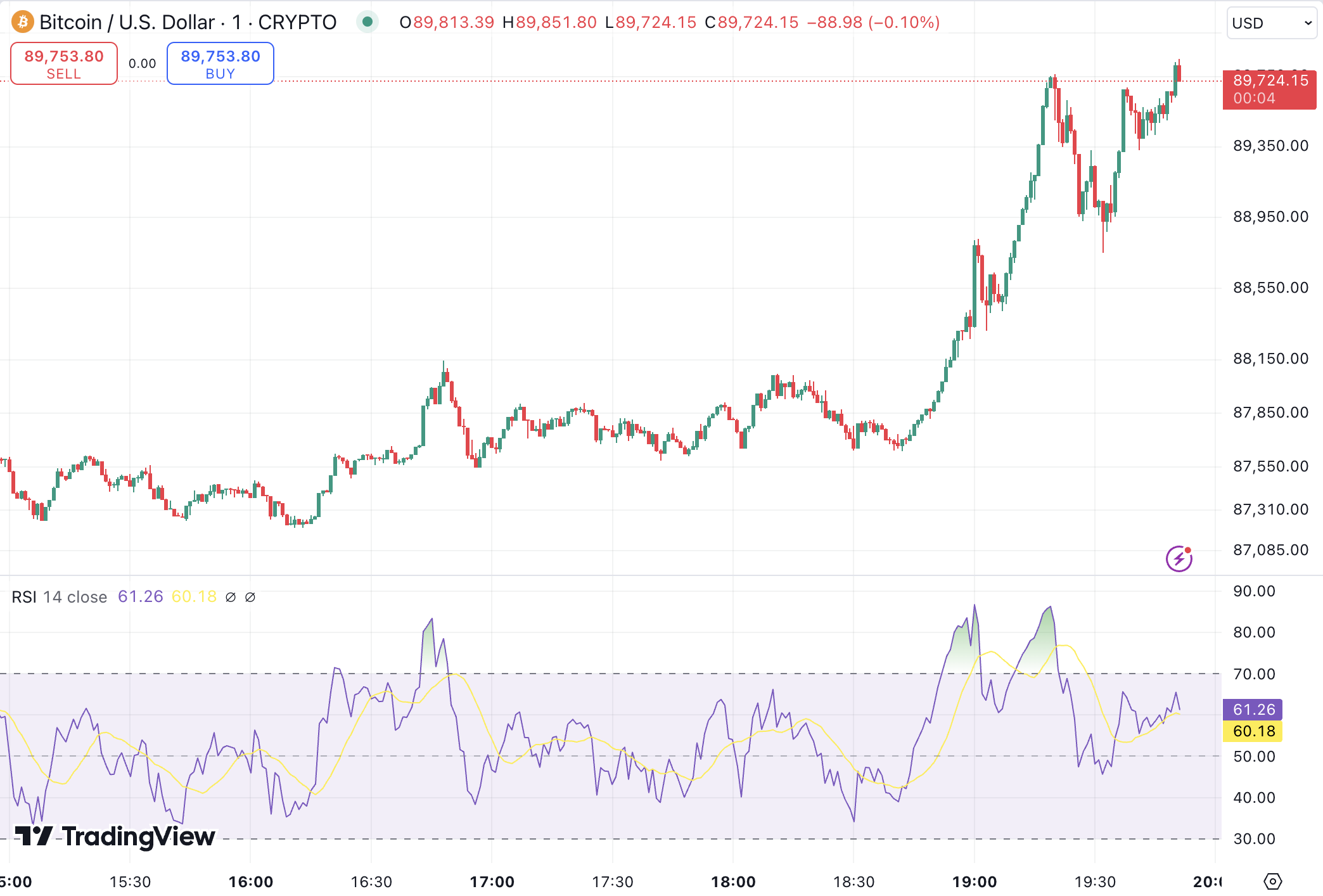
Furthermore, evaluating RSI multi-timeframe divergence provides an effective filter against false reversals. If price makes a new high while the hourly RSI forms a lower high, the bot can interpret the weakening momentum as a signal to tighten stop-losses or pause new long entries.
Backtesting RSI Rules
Before using RSI in a live bot, traders should test the timeframe, pair, stop distance, and target logic. A rule that works on EUR/USD daily charts may fail on GBP/JPY five-minute charts.
Robust backtesting across historical market cycles helps reveal how the strategy handles drawdowns, sideways action, and trend changes. Evaluating realistic metrics like profit factor and maximum drawdown is crucial before risking live capital.
Testing must also account for real-world execution variables, such as variable broker spreads, slippage during high-volatility sessions, and overnight swap charges. Standardizing testing parameters across historical data ensures that automated RSI rules remain resilient in live markets.
Where AlgoBot Adds Structure
AlgoBot-style workflows can combine RSI with additional technical readings and risk settings. This is usually more robust than treating one RSI threshold as a complete trading system.
By integrating automated stop-loss placement, position sizing, and automated take-profit rules into the signal loop, the overall system becomes far more resilient. This structure replaces manual guesswork with a repeatable, disciplined execution pipeline.
AlgoBot’s multi-indicator processing engine balances RSI inputs with trend-following baselines and dynamic ATR risk boundaries. This automated confluence ensures that order placement occurs only when technical alignment and risk metrics satisfy strict predefined rules.
Practical Example
Consider an automated strategy configured for trading EUR/USD on the 15-minute timeframe during the European market session. Rather than executing a long position the moment RSI touches 30, the trading bot evaluates a multi-step confirmation rule.
First, the bot checks that the 200 EMA on the 1-hour timeframe is sloping upward, confirming a macro bullish bias. Second, it waits for the 15-minute RSI to dip below 30 into oversold territory and then cross back above 35, confirming momentum acceleration back toward the trend.
Once all rules evaluate to true, the bot places a long market order via API, sets a protective stop-loss 1.5 times the current ATR below entry, and programs a scaled target at the 70 RSI level. The entire workflow executes automatically without human intervention.
Common Mistakes Beginners Make
- Buying instantly when RSI drops below 30 during a severe downtrend, ignoring the reality that RSI can remain oversold for extended periods.
- Failing to adjust standard 14-bar RSI settings for different market timeframes and currency pair volatility profiles.
- Deploying live RSI bots without strict stop-loss rules, exposing account balances to catastrophic drawdown during trend breakouts.
- Over-optimizing RSI threshold values (e.g., setting precise entry levels like 28.5) based on limited historical curve-fitting.
- Ignoring major economic news announcements that cause extreme price spikes capable of invalidating technical oscillator logic.
How AlgoBot Can Fit Into the Workflow
AlgoBot simplifies the implementation of complex RSI strategies by integrating momentum analysis into its pre-engineered, algorithmic signal engine. Instead of manually coding rules or managing individual indicator parameters, traders can rely on AlgoBot’s backtested logic to generate high-probability trading triggers.
The platform combines RSI momentum triggers with dynamic trend filters, volume validation, and automated position-sizing models. Whether trading major forex pairs or crypto assets, AlgoBot formats signal output into structured execution payload ready for instant terminal routing.
By removing manual calculation delays and enforcing automated risk rules—such as fixed-percentage risk management and trailing stop updates—AlgoBot empowers traders to execute disciplined RSI strategies without emotional hesitation.
Final Thoughts
RSI Trading Strategy for Forex Bots is ultimately about structure. Traders do not need more random opinions; they need clear rules, consistent execution, and risk limits that protect them during bad conditions. Automation can help with that, especially when it is paired with education and realistic expectations.
For users comparing trading tools, the strongest platform is usually the one that makes disciplined behaviour easier: clear signals, sensible risk controls, transparent setup steps, and the ability to pause or adjust when conditions change. That is the standard beginners should use when evaluating AlgoBot or any other automated trading solution.
FAQs
Is RSI better for scalping or swing trading?
It can be used for both, but the settings and confirmation rules should change by timeframe.
Should a bot buy whenever RSI is below 30?
No. RSI below 30 can signal weakness, not necessarily an immediate reversal.
What RSI setting is common?
A 14-period RSI is common, but it should still be tested for the market and timeframe.
Educational content only. Trading involves risk, and past or historical performance does not guarantee future results.