

 Share
Share



The current state of the cryptocurrency market presents both challenges and opportunities, particularly for Bitcoin investors. As we analyze the fluctuating dynamics within this volatile landscape, the critical support level of $110K for Bitcoin emerges as a pivotal point. This threshold has historically oscillated between support and resistance, illustrating its significance in determining Bitcoin’s price trajectory.
Compounding the situation are ongoing US-China trade tensions, which continue to impact market sentiment and price stability worldwide. As investors navigate their strategies while keeping a keen eye on these geopolitical factors, understanding Bitcoin price support levels becomes essential in anticipating potential corrections and price movements.
Should this $110K support fail to hold, predictions suggest a potential drop to as low as $74K, making it crucial for market participants to remain vigilant and informed in these turbulent times.
The cryptocurrency market has recently witnessed substantial volatility surrounding the critical support level of $110,000 for Bitcoin, which plays a significant role in determining investor sentiment and price direction. When Bitcoin approached this pivotal level, market analysts were closely monitoring for emerging patterns connected to previous fluctuations. Failure to maintain this support could lead to serious downward corrections, as foreseen by experts forecasting a potential drop to as low as $74,000 in a worst-case scenario. This situation emphasizes the urgency for traders to stay observant and informed.
Historically, Bitcoin has frequently tested the $110,000 support level. This repeated testing often resulted in sharp rejections, followed by further declines. Past analyses indicate that several rejections at this high price point have preceded drops of between 14% and 18%. Such patterns suggest that a continuous inability to sustain above the $110,000 mark could prompt declines toward the $100,000 level and lower.
In summary, Bitcoin’s behavior around the $110,000 support underscores the importance of technical analysis in foreseeing market movements. It also highlights the inherent risks associated with cryptocurrency trading, especially when factors like US-China trade tensions contribute to price volatility. As these geopolitical conditions can lead to swift and severe price changes, investors must fully understand these dynamics while navigating the market.
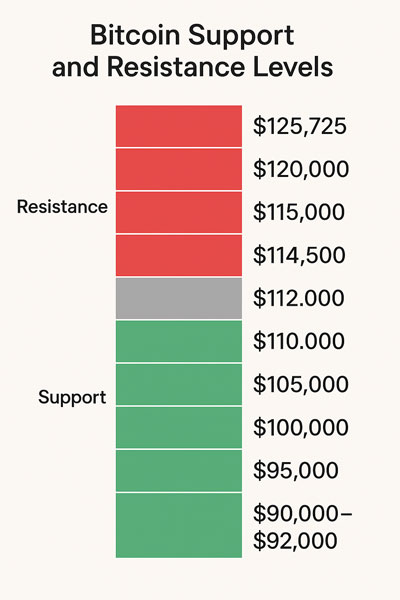
This chart illustrates the historical Bitcoin price support levels, most notably the critical $110,000 mark. It highlights essential fluctuations, prospective drop zones, and resistance levels, reflecting their importance in understanding market trends and the risks involved in cryptocurrency trading.
Implications of Losing the $110K Support Level
The $110,000 support level has become crucial in Bitcoin’s recent price movements. Analysts are raising concerns about what may happen if this support level fails to hold, with predictions ranging from adjustments toward $96,500 to more severe declines reaching as low as $74,000.
Price Corrections Ahead
If Bitcoin cannot maintain the crucial $110K threshold, analysts predict a possible immediate correction to the range of $96,500 to $100,000. This range reflects a significant psychological threshold for traders and investors and a level where substantial buying interest is likely to resurface.
However, the more troubling scenario involves a further drop to $74,000. This worst-case prediction is supported by technical analysis suggesting that historical price behavior around key support levels often leads to dramatic downward shifts when these levels are breached. As noted in a recent article, “BTC can drop to $74,000 in the worst-case scenario if the price fails to hold above the $110,000 support level” (Cointelegraph). This stark commentary underscores the dire implications for investors and market sentiment if the support level fails.
A Trader’s Perspective: Alex’s Dilemma
Consider a fictional trader named Alex. He invested his life savings of $50,000 into Bitcoin, hoping to secure a future for his family. As he watches the price hover around the critical $110K support level, anxiety sets in. If that support fails, he fears losing everything. A social media post from a friend about his investment losses intensifies Alex’s worries, making the emotional stakes even higher.
This narrative illustrates how market fluctuations affect individual lives, adding a human element to the data and predictions.
Increased Selling Pressure
Market indicators suggest that Bitcoin currently faces significant selling pressure, further complicating the outlook. Reports indicate that the Taker Buy-Sell Ratio has plummeted, which points towards intensified selling from traders. Additionally, institutional selling has surged, with influential players reducing their Bitcoin holdings considerably. A CoinAlertNews analysis noted, “Institutional selling has intensified, with reports of major players like BlackRock reducing their Bitcoin holdings”. This institutional sentiment can have cascading effects, instigating panic among retail investors and amplifying downward price movements.
Analysts’ Warning
With these elements at play, analysts are urging caution. It’s noted that Bitcoin’s position below all major Exponential Moving Averages (EMAs) and a low Relative Strength Index (RSI) signals an oversold condition, indicating a precarious situation. An analyst from Swissblock highlighted the importance of the $110K support, referring to it as a “make-or-break point”, emphasizing that failing to maintain this level may prompt deeper corrections.
Conclusion
In summary, Bitcoin’s failure to hold the $110K support level could set off a chain reaction of selling behavior, significant price corrections, and heightened market volatility. Investors should remain vigilant, as maintaining awareness of critical support levels like $110,000 is essential amid the unpredictable nature of cryptocurrency markets.
Crypto Market Crash Analysis
The cryptocurrency market experienced a staggering $19 billion crash in early October 2025, primarily influenced by geopolitical tensions and sudden regulatory developments. Here are key statistics and insights that illustrate the impact of this significant event:
- Market Movements: On October 10, Bitcoin’s price fell from approximately $112,000 to a low of around $110,000 due to panic-selling amid news of a 100% tariff on Chinese imports by President Donald Trump, igniting volatility across the market.
- Controlled Deleveraging: Analysts have suggested that the crash represented a controlled deleveraging rather than a cascading sell-off. Despite the liquidity drop, only about $1 billion in long Bitcoin positions were liquidated, indicating a more stabilized market environment. This aligns with statements from analysts who referred to it as an instance of “organic deleveraging.”
- Investor Sentiment: Following the crash, the options trading market saw a spike in put contracts, reflecting a shift towards bearish sentiment among investors looking to hedge against further downturns. This suggests a cautious outlook as many traders brace for potential volatility.
- Market Recovery Signs: While the immediate aftermath saw significant fear, Bitcoin maintained a dominance of approximately 58.45% in the crypto market, indicating a consolidation of capital toward more established assets. This resilience points towards investor confidence in Bitcoin as a long-term store of value despite short-term fluctuations.
- Current Bitcoin Trends: As of now, Bitcoin is priced around $112,446, with fluctuating intraday movements between $110,099 and $113,538. Overall, analysts emphasize the need for continuous observation of support levels, particularly the critical $110,000 threshold. Losing this pivotal support may trigger further declines and heightened volatility in the market.
This analysis of the recent events reveals the intricate interplay between market sentiment, current Bitcoin valuations, and broader economic influences. Investors must remain vigilant and informed, particularly during such tumultuous periods in the cryptocurrency landscape.
Emotional Trading and Market Behavior
Emotional trading, particularly during periods of heightened political events like U.S.-China trade tensions, has significantly influenced Bitcoin’s market behavior. Analysts from Santiment, including Brian Q., have observed that retail investors often react emotionally to such geopolitical developments, leading to market volatility.
For instance, on October 10, 2025, Bitcoin’s value fell by 8.4% to $104,782 following President Donald Trump’s announcement of a 100% tariff on Chinese imports. This aggressive trade measure rattled global financial markets, with the S&P 500 index dropping over 2%. Ethereum also declined, falling 5.8% to $3,637. The market response highlights investor concerns over the escalating economic conflict between the two countries and its implications for global markets and digital assets [Reuters].
Santiment analyst Brian Q. noted that emotional trading tied to political news continues to dominate short-term market behavior, arguably more than ever in crypto’s history. He observed that retail investors often overreact to geopolitical events, leading to panic selling. However, “smart traders” tend to capitalize on these moments by purchasing assets at lower prices, anticipating a market rebound once the initial fear subsides [Cointelegraph].
This pattern was evident when, following the largest crypto liquidation in history on October 10-11, 2025—totaling over $19 billion—investors moved aggressively to hedge against further volatility. The crash was triggered by the U.S. President’s surprise announcement of a 100% tariff on Chinese imports, which sparked panic selling and low liquidity. Bitcoin dropped over 14% to a low of $104,783, while ether plunged 12.2% to $3,436. The altcoin market saw even steeper declines, with losses in HYPE (-54%), DOGE (-62%), and AVAX (-70%) before partial recoveries [Reuters].
In summary, emotional trading in response to U.S.-China trade tensions has led to significant volatility in the Bitcoin market. While retail investors often react with panic selling during such events, more experienced traders may view these downturns as buying opportunities, anticipating market corrections once the initial fear dissipates.
User Sentiment Data on Bitcoin Trading
The current market conditions for Bitcoin are heavily influenced by investor sentiment, particularly in response to geopolitical events like the recent U.S.-China trade tensions. Recent analysis reflects a significant downturn in sentiment due to escalating fears and uncertainties, prominently characterized by what is termed ‘Crowd FUD’ (Fear, Uncertainty, Doubt). This phenomenon is exemplified by the considerable price drops witnessed in early October 2025, where Bitcoin’s value fell by as much as 8.4% in a single day, coupled with a $19 billion crash in the crypto market.
The Role of Crowd FUD in Price Movements
Investor reactions to political announcements and economic shifts can lead to notable impacts on Bitcoin’s price. Following President Trump’s announcement of a 100% tariff on Chinese imports on October 10, Bitcoin saw a panic sell-off that decreased its value, reflecting the immediate fear among retail investors. This is a clear instance of how market sentiment can trigger drastic price movements, as emotional trading is often exacerbated during uncertain geopolitical climates. Analysts noted that retail traders tend to react impulsively to such news, leading to collective behaviors that can further drive down prices.
Reports from the trading front highlight that options activity surged, with many investors purchasing put contracts as a hedge against anticipated declines, indicating a shift towards bearish sentiment. The psychological pressure from ‘Crowd FUD’ can create a cascading effect, prompting more investors to sell in fear of deeper losses.
Emotional Trading Trends
The overall impact of emotional trading has led to significant market volatility. Analysts have observed that, rather than seeing these instances solely as detrimental moments, savvy investors often recognize buying opportunities. This contrasts sharply with the impulsive reactions of less experienced investors, who may capitulate during market downturns. The reactionary selling can lead to substantial losses for these investors, particularly evident during the record liquidation event earlier when Bitcoin fell below critical support levels.
Conclusion
In summary, understanding market sentiment in Bitcoin trading is crucial for navigating the inherent volatility of cryptocurrency markets. Geopolitical events play a pivotal role in shaping investor emotions, and recognizing the patterns of ‘Crowd FUD’ can help informed traders capitalize on market dynamics rather than react out of fear. As the crypto market continues to evolve, maintaining awareness of these sentiment-driven trends is essential for effective trading and investment strategies.
For further insights, refer to the following key articles:
Conclusion
In summary, traders and investors must closely monitor Bitcoin’s price dynamics, particularly around the critical support level of $110,000. This area not only signifies a crucial make-or-break point for Bitcoin but also encapsulates the market’s response to geopolitical events, especially U.S.-China trade tensions. Analysts predict that should this support fail, significant price corrections could occur, with estimates ranging from a downturn toward $96,500 to the potential drop to $74,000. This sensitivity to support levels highlights the importance of technical analysis in navigating the rocky waters of the cryptocurrency market.
Moreover, the prevailing market sentiment, influenced by factors like emotional trading behaviors tied to political announcements, further complicates price stability. As observed, many traders exhibit tendencies toward panic selling during periods of heightened anxiety, sometimes exacerbating losses. Yet, keen traders have found opportunities in these declines, identifying points for potential rebounds.
Therefore, to thrive in this volatile environment, it is paramount for Bitcoin traders to maintain ongoing awareness of market sentiment, understand the implications of support levels, and stay informed about the political landscape that could influence price movement. Keeping abreast of these trends will equip traders to better navigate the challenges ahead as they strategize for the upcoming market dynamics. Stay informed, stay strategic, and continue engaging in thorough analysis as Bitcoin’s journey unfolds.
| Scenario | Expected Price Range |
|---|---|
| Holding Above $110,000 | $110,000 and above |
| Correction Towards $100,000 | $96,500 – $100,000 |
| Dropping to $74,000 | $74,000 |
Implications of Losing the $110K Support Level and Crypto Market Crash Analysis
The $110,000 support level for Bitcoin has recently become a focal point for analysts as its stability influences market sentiment and price direction. Concerns about what could happen if this support level fails to hold are rising, with predictions indicating adjustments towards $96,500 or more severe declines reaching as low as $74,000.
Price Corrections Ahead
If Bitcoin fails to maintain the crucial $110K threshold, analysts forecast an immediate correction within the $96,500 to $100,000 range. This tier is of particular psychological importance to traders and is expected to attract significant buying interest. However, the more alarming scenario involves a potential drop to $74,000, a worst-case prediction corroborated by historical price behavior which often suggests dramatic declines upon breaching key support levels.
Market indicators show Bitcoin is presently under significant selling pressure. The recent events surrounding a staggering $19 billion crash in early October 2025, driven by geopolitical tensions like the U.S.-China trade conflict, further exacerbate the situation. Panic selling ensued after President Trump’s announcement of a 100% tariff on Chinese imports, flipping Bitcoin’s price trajectory dramatically from around $112,000 to a low of about $110,000.
Analysts have coined this mass liquidation as a “controlled deleveraging,” suggesting it was not merely a cascade of sell-offs but rather an organic reaction to market instability. Despite this drama, Bitcoin retained approximately 58.45% dominance in the overall crypto market, indicating a consolidation around more established assets, reflecting a degree of investor confidence despite short-term volatility.
Moreover, the options market experienced a notable shift towards bearish sentiment, as investors increasingly purchased put contracts to hedge against further downturns. This indicates a cautious outlook among investors in light of the market’s recent turmoil.
Conclusion
In conclusion, the fate of Bitcoin remains heavily tied to the $110,000 support level. Losing this crucial support may trigger not only sharp price corrections but also a cascade of panic selling amid heightened market volatility driven by emotional trading in response to geopolitical events. Therefore, Bitcoin traders must closely monitor these dynamics to navigate the volatile crypto landscape successfully. Awareness of support levels and investor sentiment, particularly during periods of geopolitical uncertainty, is essential for making informed trading decisions.